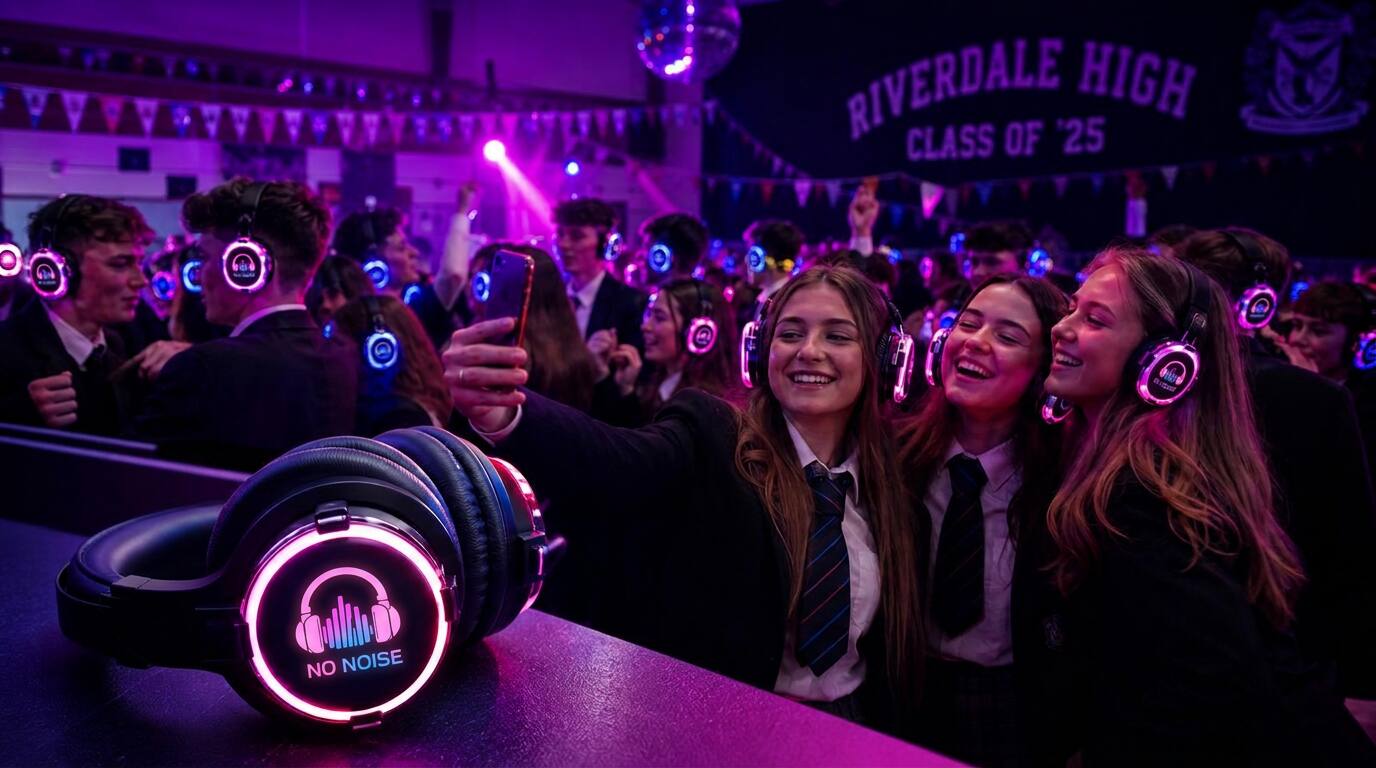
Silent discos have become the default for school events across Devon primary and secondary schools, for two very practical reasons: they don't disturb the classes next door, and the volume is set per-pupil so there's no debate about "is the music too loud for this age group?". This guide covers the bits that teachers and PTAs need to have ready before enquiring.
Which school events silent discos work for
- End-of-term discos (KS1, KS2, KS3 and KS4).
- Year 6 leavers' parties.
- Sixth-form socials and Christmas events.
- School proms (Year 11 and Year 13) — see our prom page.
- PTA fundraisers and family discos.
- Reward events for whole classes or year groups.
- Wet-weather sports day alternatives.
Sizing — the whole-school mistake
The most common sizing mistake is: "we have 240 pupils so we need 240 headphones." You don't. You need enough for the largest single group in the room at once. If you're running KS1 in the morning and KS2 in the afternoon, you're sizing for whichever key stage is bigger.
Typical Devon primary rotation:
- 50-pack — one class at a time, or Year 6 leavers.
- 100-pack — whole key stage (KS1 or KS2) in one session.
- 150-pack — whole primary school in a single hall.
Risk assessment — what to include
Most schools include silent disco kit under the standard "hall event" risk assessment. The specific points to note:
- PAT testing — all our kit is PAT tested annually; certificates available on request.
- Public liability insurance — we're covered to £5m; we can send our current certificate for your file.
- Trip hazards — one power cable to the transmitter, gaffer-tape if it crosses a walkway (we bring tape).
- Volume safety — headphones are individually volume-controlled by each pupil. Maximum output is set below the WHO recommended safe listening level for children.
- Hygiene — all headphones are wiped down and sanitised between hires; wipes are provided on the day for teacher use if needed.
A silent disco doesn't need an on-site operator — teachers usually run it themselves from a school laptop or phone. If you choose to add an operator for £20/hour, our team hold enhanced DBS certificates and stay in the hall with school staff at all times.
Running rotations for multiple year groups
The classic Devon primary format for a whole-school Christmas disco:
- 9:30–10:15 — Reception & KS1 session.
- 10:15–10:30 — Changeover, headphone wipe, quick charge check.
- 10:30–11:30 — Lower KS2 session.
- 11:30–11:45 — Changeover.
- 11:45–12:45 — Upper KS2 session.
This runs comfortably on a single 100-pack. Tell us the rotation in your booking and we'll deliver early enough for morning setup.
Music planning
Most schools use a class Spotify playlist or a teacher's Apple Music library. We recommend three prepared playlists — chart hits (clean radio edits), Disney / movie soundtracks, and a "silly songs" playlist. If your school has a music filter policy, review each playlist for language in advance.
For sixth-form and prom events, put a student committee in charge of the playlists — they'll take it far more seriously than a teacher would, and you'll get better results.
10% off Monday–Thursday
School and college bookings for events on Monday, Tuesday, Wednesday or Thursday receive an automatic 10% discount — because we'd rather see the kit used mid-week than sat in a van. This applies to end-of-term discos, PTA events and daytime rewards.
Booking timeline
- End-of-term events — book at least 4 weeks ahead; last week of term fills fast.
- Christmas discos — book by mid-October.
- Summer proms — book by February for reliable dates.
We hold provisional dates for schools while purchase orders come through — just say so in your enquiry.
Planning a school event? Check availability with your event date, expected numbers and year groups, and we'll come back with a formal quote and any documentation your finance team needs.